
Busejra Daci, PhD Candidat in the European Union Program, Istanbul University
/
The discourse surrounding North Macedonia’s European trajectory has undergone a fundamental shift in 2026, moving beyond the traditional political “waiting room” mentality toward a rigorous focus on social-economic convergence. While the formal opening of negotiationg clusters of readiness is “real convergence” the tangible process by which a candidate nation’s productivity, income levels, and institutional quality align with the European Union (EU) average. For North Macedonia, the current year represents a critical juncture where structural reforms, heavily backed by the EU’s €6 billion Reform and Growth Facility, are being tested against the harsh realities of a globalized aconomy. The most formidable challenge facing North Macedonia remains the significant disparity in living standards as measured by Gross Domestic Product (GDP) per capita in Purchasing Power Standards (PPS). In April 2026, North Macedonia’s GDP per capita stands at approximately $31,750, which is roughly 46.7% of the EU-27 average of $67,960. While this reflects a steady climb from the 41% range seen earlier in the decade, this “Convergence Gap” remains the primary driver of regional migration and talent flight. Although growth in early 2026 has been resilient, averaging 3.5% due to major infrastructure projects like Corridors VIII and X, the consensus among researchers is that for North Macedonia to reach 70%of the EU average within the next decade, annual growth must exceed 5%. This necessitates a radical departure from a growth model dependent on low-complexity manufacturing toward one fueled by Total Factor Productivity, which focuses on extracting higher output through technological integration rather than just labor volume. A core dimension of this structural analysis is the persistent “Innovation Gap”. In 2025, North Macedonia’s investment in Research and Development (R&D) was estimated at a mere 0.40% of GDP, a marginal increase that remains significantly below the EU average of 2.3%. This lack of R&D intensity traps the economy in a middle-income cycle where it is too expensive to complete with low-wage global markets but not sufficiently innovative to complate with high-tech European hubs. Furthmore, the “Human Capital Paradox” complicates this transition. While tertiary education enrollment is numerically high, there is a stark mismatch between university curricula and the demands of the 2026 labor market. The youth unemployment rate, while improving to approximately 30% in the first quarter of 2026, suggests that the country’s most valuable resource -its intellectual capital- continues to seek better living standards abroad rather than contributing to domestic modernization.
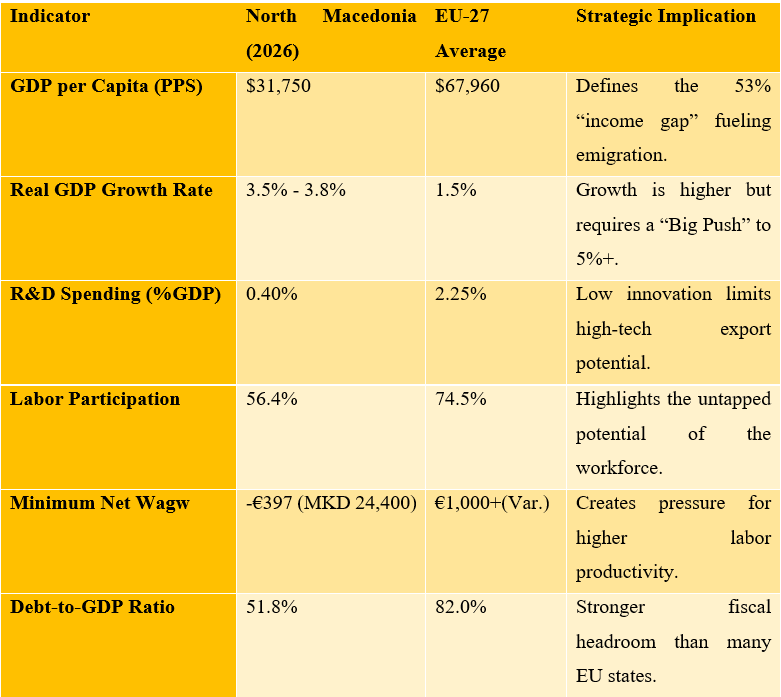
Source: Complied from IMF World Economic Outlook (2026), State Statistical Office (May 2026), and Eurostat Convergance Reports.
In 2026, the implementation of the EU Reform and Growth Facility for the Western Balkans has emerhed as the primaru engine for accelerating this convergence. North Macedonia has recently secured tranches of funding conditioned on specific “Reform Agendas” that target the roots of underdevelopment. The first pillar of this transformation is the “Digital Twin Transition”, focusing on the massive digitalization of public services to reduce the informal economy currently estimated at nearly 20% of GDP and eliminate the structural patronage that has historically slowed judicial and administrative efficiency. Simultaneously, energy decarbonization is being prioritized through the integrated National Energy and Climate Plan 2025-2030. By shifting from lignite-based power to solar and wind, North Macedonia is proactively shielding its exporters from the EU’s “Carbon Border Tax”, which would otherwise penalize high-carbon products entering the Single Market. The empiricial data confirms that joining the European Union is not a single political event but a cumulative achievement of socio-economic living standards. To reach the necessary conditions for membership as quickly as possible, the focus in late 2026 must remain on institutional resilience and productivity shocks. When the rule of law is predictable, the energy grid is green, and the workforce is skilled in digital technologies, the “Convergence Gap” will naturally close. Accession should be viewed as the byproduct of becoming a modern, efficient state; when these conditions are met, membership becomes a logical formality rather than a diplomatic struggle. For North Macedonia, the objective is to transform from a candidate on the periphery into an indispensable, productive component of the European project.

The International Symposium on Balkan Periodicals: Trajectory of Islamic Thought, 1990–2018 has successfully concluded
Balkan Studies Foundation took part in Anadolu Agency’s Green Lens Program
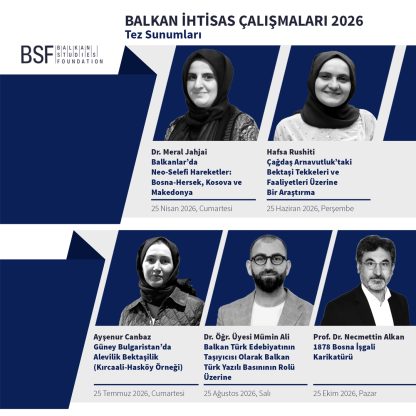
Balkan İhtisas Çalışmaları 2026 Tez Sunumları