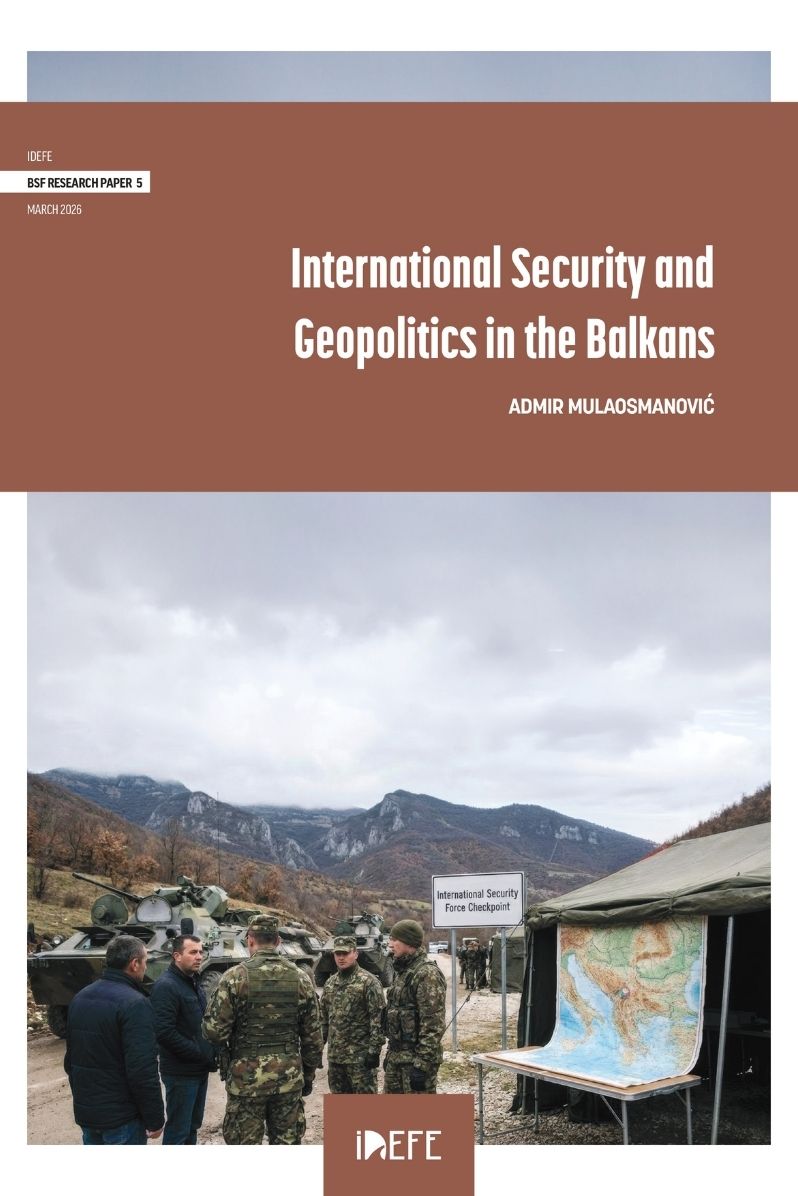
Admir Mulaosmanović
IDEFE Publications, 2026
32 pp.
ISBN: 978-608-4944-34-8
/
Abstract: The region of Southeast Europe, as a post-communist and post-socialist region, has been going through a series of transition processes in the last thirty years. The disappearance of the common state of the South Slavs/Yugoslavia, the devastation of war and the wider demographic collapse, and complex national relations have burdened democratic processes to the extent that every issue in the Balkans is the subject of major and fundamentally important debates.
In the new and fundamentally changed geopolitical circumstances that have led to the growth of new centers of power, the growth of a multipolar world, the Balkans region is becoming a significant zone of conflict between global powers. This region is not at all immune to impulses coming from Eurasian space, especially after the NATO alliance’s attempt to move the “great border” to the banks of the Dnieper. Serious opposition to this approach in Europe, first in Hungary and then in Slovakia, led to a series of complex political processes in Central and Southeast Europe. With growing Turkish dissatisfaction with the attitude of Western partners towards Ankara, the question of NATO’s strategic goals began to be raised.
The withdrawal from Afghanistan indicated the American understanding that they were facing a great burden (imperial overload), but it also opened a discussion about the future of the global influence of liberalism and the West in general. This crisis of liberal hegemony, which led to a new approach and repositioning of world powers and rising powers, began to be clearly observed after 2016 in the actions of China, as well as in the emergence of a new American isolationism that was very pronounced during Trump’s first term, and even more so during the past 2025, in which Trump took dramatic steps.
The great topic of a multipolar world and a new order was opened, so that the entire European continent, due to its visible loss of position on the global level, can be problematized as a space of possible polar non-belonging. The latest events (the Greenland affair in particular) clearly demonstrate this.
In this sense, the Balkan peninsula, as the “soft belly” of European geopolitics, but also the centuries-old “in-between space”, is in a dead end bordered by regional hegemons and their national interests on the one hand and the aspirations of pro-democratic, weaker states on the other.
Keywords: Bosnia and Herzegovina (BiH), European Union (EU), Geopolitical shifts