Eds. Sevba Abdula, Zehra A. Sadiki
IDEFE Publications, 2025
840 pp.
ISBN: 978-608-4944-27-0
/
The social sciences, encompassing disciplines such as history, literature, sociology, political science, anthropology, economics, law, and cultural studies, play a vital role in advancing our understanding of human societies, their structures, and the dynamics that shape their development. These fields provide fundamental insights into the complexities of human behavior, social institutions, politics, economies, and legal frameworks. As our world becomes increasingly interconnected, the importance of interdisciplinary research in the social sciences has never been greater, offering the potential to address the pressing challenges facing contemporary societies and to provide solutions to complex global issues.
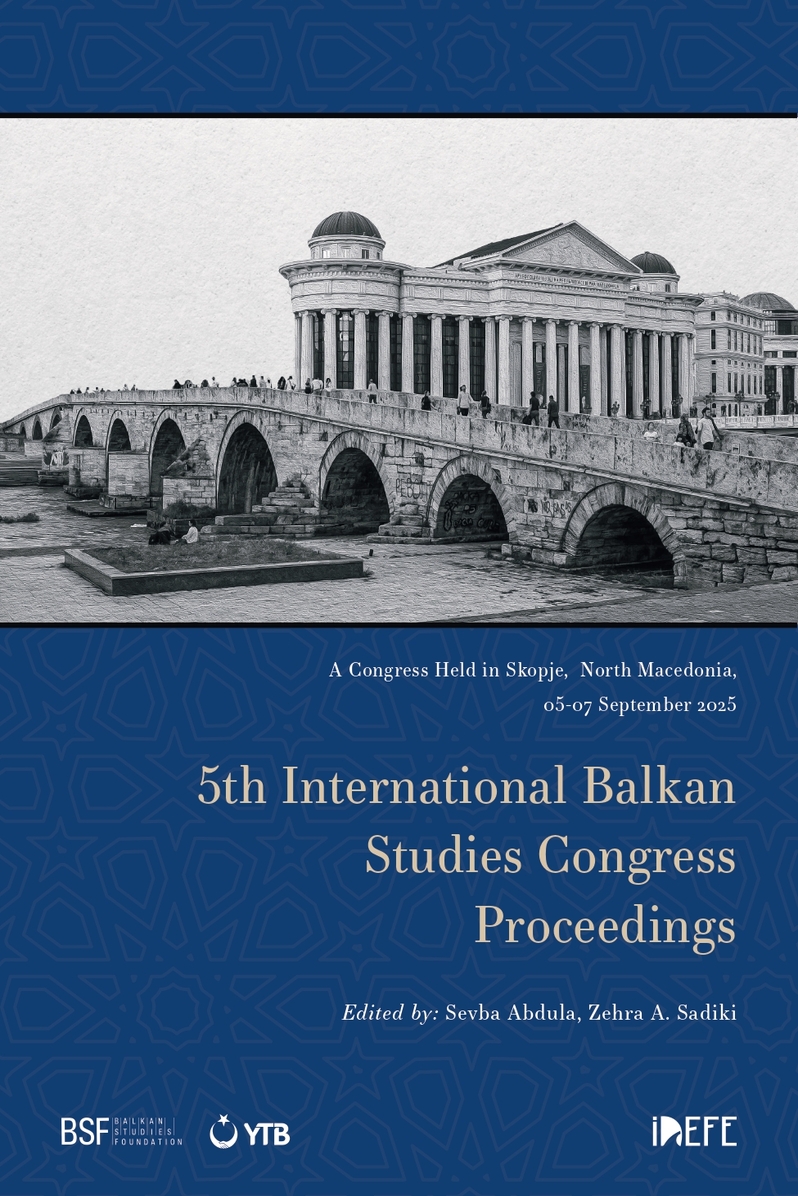
The 5th International Balkan Studies Congress has been actively operating for years with the aim of fostering interdisciplinary collaboration and deepening scholarly research on the Balkan region. We extend our gratitude to over 200 young researchers who have contributed their work to this Congress. For the past five years, these studies have offered diverse, creative, and impactful perspectives on the complex and multifaceted issues of the Balkans.
The primary objective of our Congress is to create a dynamic platform for scholars to share research findings, insights, and innovative ideas related to Balkan studies. By fostering a learning environment focused on collaboration and participation, our congress encourages discussions across a broad range of disciplines—such as history, literature, sociology, politics, economics, law, and cultural studies—enabling participants to deepen their understanding of the multifaceted complexities within the Balkan region. This gathering provides an invaluable opportunity for academics to present their work, interact with their peers, and contribute to an ongoing dialogue that expands our knowledge of the Balkans.
Organized as an international event, the Congress also aimed to promote the production of high-quality, original academic output and to support cross-cultural dialogue. By bringing together scholars from diverse geographical and academic backgrounds, the Congress created a unique opportunity for participants to gather in a Balkan country, exchange ideas, and engage in discussions that allow for a more in-depth exploration of the themes at hand. Over the course of two days, each academic attended sessions aligned with their field of expertise, listened to presentations, and participated in thought-provoking discussions that enriched their understanding of the region.
We extend our sincere appreciation to the organizing committee for their meticulous planning of this Congress and for their extraordinary efforts in uniting academics from a wide array of disciplines. Their commitment to creating a space for meaningful academic exchange has been central to the success of this event.
Our heartfelt thanks also go to the diligent reviewers, whose expert feedback and constructive critiques have been instrumental in enhancing the scholarly rigor and academic integrity of this publication.
Lastly, we extend sincere acknowledgment to our esteemed Congress partners: The, Presidency for Turks Abroad and Related Communities, Istanbul Medeniyet University, International University of Sarajevo, HUN-REN Centre for Economic and Regional Studies, South East European University, University of Tetova and ILEM: Scientific Studies Association. Special thanks also go to Hanife Etem and Elif R. Nazim, for their unwavering support and essential contributions. Their collaboration has been indispensable in ensuring the successful realization of this ambitious academic endeavor.