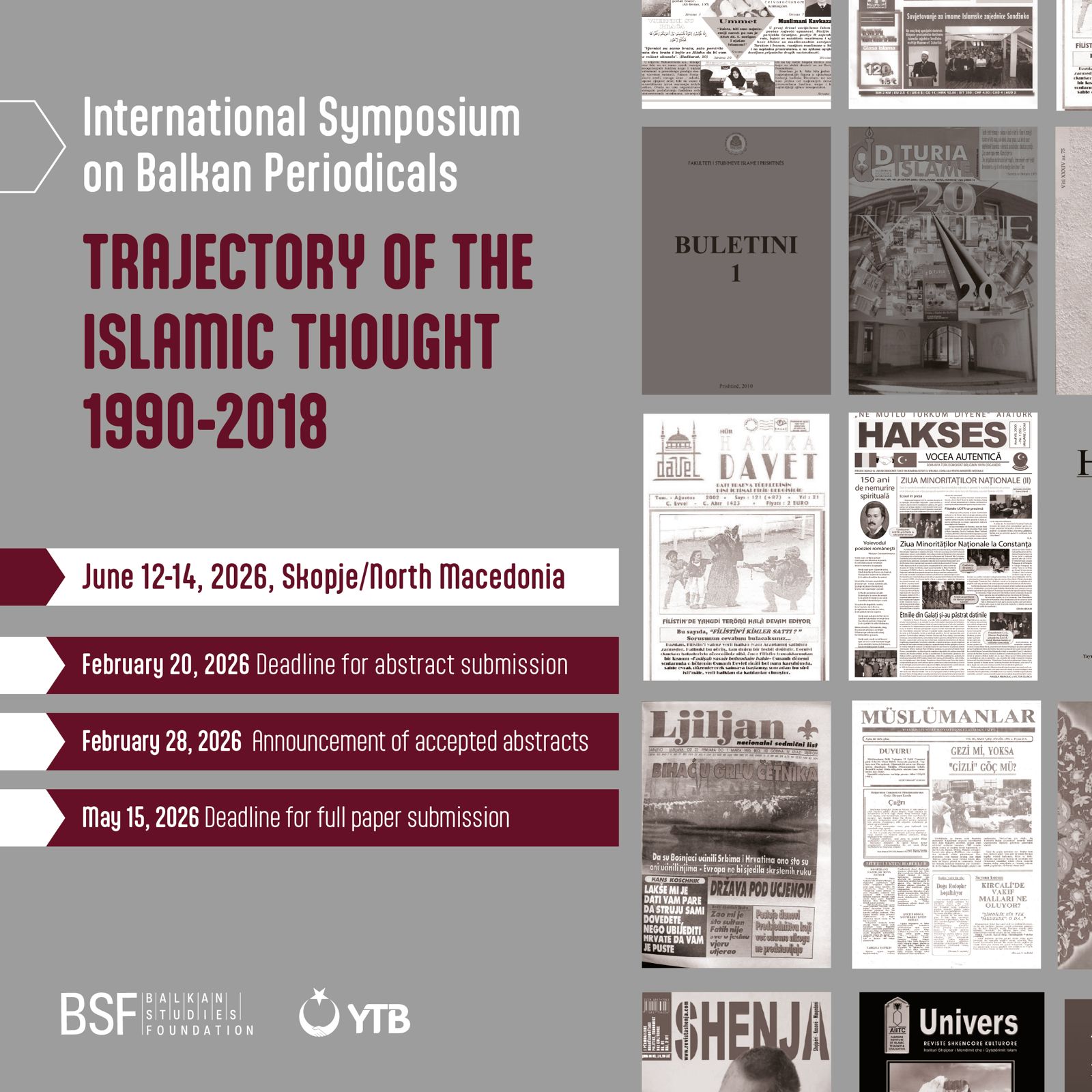
June 12-14, 2026
Skopje/North Macedonia
/
CALL FOR PAPERS
The study of contemporary Islamic thought in the Balkans has been gaining increasing significance, necessitating deeper and comparative research. Examining contemporary thought comprehensively through primary sources like periodicals offers significant momentum to such studies. The Balkans, hosting various ideologies and experiencing diverse political regimes, have served as a laboratory for social and political developments.
In the past century, the Balkans have been directly impacted by two world wars, witnessing numerous unifications and divisions at the state level. Politically and intellectually, this period saw significant shifts. At the start of the century, Muslims in the region became minorities and underwent various nation-building processes. Between the end of World War II and the 1990s, Muslims faced challenging and oppressive conditions. With the post-1990 global transformations, new dynamics emerged: Islam and Muslims became more visible in public life, engaging with the European Union and the Islamic world, resulting in the production of new identities and cultures.
Throughout the last century, Islamic thought in the Balkans has explored diverse topics such as jurisprudence, theology, state, society, politics, nation, culture, and gender. Periodicals like magazines and newspapers have been prominent mediums for these discussions. Studying these periodicals from 1918 to 1945, 1945 to 1990, and 1990 to 2018 provides a structured understanding of the topics, concepts, actors, and institutions shaping Islamic thought in the Balkans. These studies are crucial for tracing the development and trajectory of Islamic thought in the region and for analyzing the transformations, continuities, and ruptures in Bosniak, Albanian, and Turkish Muslim identities across countries and regions.
An international symposium titled International Symposium on Balkan Periodicals: The Trajectory of Islamic Thought, 1918-1945″ was held in Skopje, North Macedonia, on February 24-25, 2024. Over 30 presentations on periodicals were delivered by participants from eight different countries.
An international symposium titled International Symposium on Balkan Periodicals: The Trajectory of Islamic Thought, 1945-1990″ was held in Skopje, North Macedonia, on June 13-15, 2025. Over 37 presentations on periodicals were delivered by participants from eight different countries.
In 2026, the third phase of this project will focus on the 1990-2018 period, examining periodicals published in Albania, Bosnia and Herzegovina, Bulgaria, Kosovo, North Macedonia, Greece, Montenegro, Croatia, Serbia, and Romania. These publications will be analyzed concerning the fundamental themes of Islamic thought during this period.
Balkan Periodicals: The Trajectory of Islamic Thought, 1918-2018 project is managed by the Balkan Studies Foundation (BSF) and supported by the Presidency for Turks Abroad and Related Communities (YTB).
Papers at the symposium can be presented in English, Turkish, Albanian, or Bosnian. The symposium organizing committee will cover all accommodation and meal expenses for participants.
/
Application Link:
https://forms.gle/SzfVDxARmEAYhYSW8
/
Below are examples but not limited of periodicals published in Balkan countries during the 1990-2018 period.
Albania: Zani i Nalte, Univers, Drita e Kur’anit, Etika, Drita Islame
Kosovo: Takvim, Edukata Islame, Dituria Islame, Studime Islame, Buletini, Paqja, Frymezimi, Hikmet
Bosna-Hercegovina: Ljiljan, Novi Muallim, Dani, Forum Bosnae
North Macedonia: Albislam, Dituria, El Hilal, Shenja
Greece: Hür Hakka Davet, Mihenk, Rehber
Serbia: Nur, Glas islama
Montenegro: Elif, Almanah
Bulgaria: Müslümanlar/Мюсюлмани, Kalem, Мюсюлманско общество (Müsülmansko obştestvo), Селям (Selam), Икра (İkra), Hak ve Özgürlük, Kırcaali Haber
Romania: Hakses, Müftiyat, Islamul Azi
Croatia: Bošnjačka pismohrana, Behar
/
Important Dates
February 20, 2026, Deadline for abstract submission
February 28, 2026, Announcement of accepted abstracts
May 15, 2026, Deadline for full paper submission
May 25, 2026, Announcement of the accepted papers
June 01, 2026, Announcement of the the symposium guide
June 12-14, 2026 Organization of the symposium
/
Symposium Organizing Committee
Assist. Prof. Dr. Ahmet Köroğlu, Istanbul University, Türkiye (Chair)
Dr. Sevba Abdula, Balkan Studies Foundation, North Macedonia
Assist. Prof. Dr. Serdar Serdaroğlu, International Balkan University, North Macedonia
Assist. Prof. Dr. Mustafa Sacid Öztürk, Kırkareli University, Türkiye
Assoc. Prof. Dr. Hamdi Çilingir, Sakarya University, Greece
Dr. Sedad Beslija, University of Sarajevo, Bosnia and Herzegovina
Vedat S. Ahmed, Muslim Denomination, Bulgaria
Dr. Besir Neziri, Islamic Community of Kosovo, Kosovo
Dr. Besnik Emini, Institute of Spiritual and Cultural Heritage of Albanians, North Macedonia
Assist. Prof. Dr. Fatih Şabani, Trakya University, Albania
Muhammed Eser, Presidency for Turks Abroad and Related Communities, Türkiye
/
Secretariat
Zehra A. Sadiki, Balkan Studies Foundation, North Macedonia
/
Symposium Scientific Committee
Prof. Dr. Mehmet Görmez, International University of Türkiye for lslam, Science and Technology, Türkiye
Prof. Dr. Ihsan Fazlıoğlu, Istanbul Medeniyet University, Türkiye
Prof. Dr. Cemil Aydın, The University of North Carolina, USA
Prof. Dr. Musa Musai, University of Tetova, North Macedonia
Prof. Dr. Qufli Osmani, University of Tetova, North Macedonia
Prof. Dr. Ekrem Demirli, Istanbul University, Türkiye
Prof. Dr. Murteza Bedir, Istanbul University, Türkiye
Prof. Dr. Mehmet Bulut, Istanbul Sabahattin Zaim University, Türkiye
Prof. Dr. Şener Bilal, International Balkan University, North Macedonia
Prof. Dr. Petar Todorov, Institue of National History, North Macedonia
Prof. Dr. Hana Younis, University of Sarajevo, Bosnia and Herzegovina
Assoc. Prof. Dr. Lindita Latifi, University of New York-Tirana, Albania
Assoc. Prof. Dr. Ali Erken, Marmara University, Türkiye
Assoc. Prof. Dr. Mevludin Ibishi, International Balkan University, North Macedonia
Assoc. Prof. Dr. Zahit Atçıl, Istanbul Medeniyet University, Türkiye
Assoc. Prof. Dr. Abdülkadir Macit, Kocaeli University, Türkiye
Assoc. Prof. Dr. Ertuğrul Karakuş, Kırklareli University, Türkiye
Assoc. Prof. Dr. İbrahim Halil Üçer, Istanbul Medeniyet University, Türkiye
Assoc. Prof. Dr. Alim Arlı, Istanbul Technical University, Türkiye
Assoc. Prof. Dr. Yunus Uğur, Marmara University, Türkiye
Assoc. Prof. Dr. Süleyman Güder, Istanbul University, Türkiye
Assoc. Prof. Dr. Ermin Sinanovic, Center for Islam in the Contemporary World, Türkiye
Assoc. Prof. Dr. Ercüment Asil, Fatih Sultan Mehmet University, Türkiye
Assist. Prof. Dr. Bujamin Bela, Mother Teresa University, North Macedonia
Assist. Prof. Dr. Selime Hasanova, Sofia Higher Islamic Institute, Bulgaria
Assist. Prof. Dr. Memiş Merdan, Constantine of Preslav Shumen University, Bulgaria
Assist. Prof. Dr. Plarent Ruka, University of New York-Tirana, Albania
Assist. Prof. Dr. Drita Memeti, University of Tetova, North Macedonia
Assist. Prof. Dr. Agron Islami, Ali Hadri Institute of History, Pristina, Kosova
Dr. Deniz Memedi, Mother Teresa University, North Macedonia
Dr. Kenan İsmaili, Muftiny of Skopje, North Macedonia
Dr. Necdet Subaşı, Ministry of National Education, Türkiye
Dr. Hüseyin Bostancı, Bakesh, Greece
Dr. İbrahim Zeyd Gerçik, Marmara University, Türkiye
/
Article Writing Rules
Please take note of the following writing rules to ensure your submission aligns with the symposium standards:
details:

Osmanlı Avrupası’nda Edebiyat, 1400-1800 Başvuruları Başladı!
Ramadan Talks 2026 “Ramadan and Us: Perspectives from Different Experiences” applications are now open!
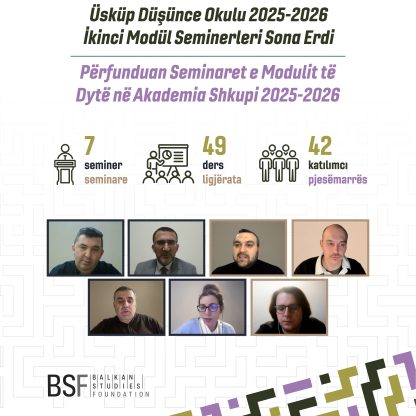
Second Module of the Skopje Academy 2025 – 2026 Seminars Have Successfully Concluded